Private Pilot Study Guide
by Brian Rutledge
The helicopter private-pilot oral exam is a conversation skill that lives separately from flying. Brian Rutledge's spiral-bound study guide is the best tool I found for practicing that skill. Here is how I used it to earn my certificate.
ISBN 9781647754297
View on Amazon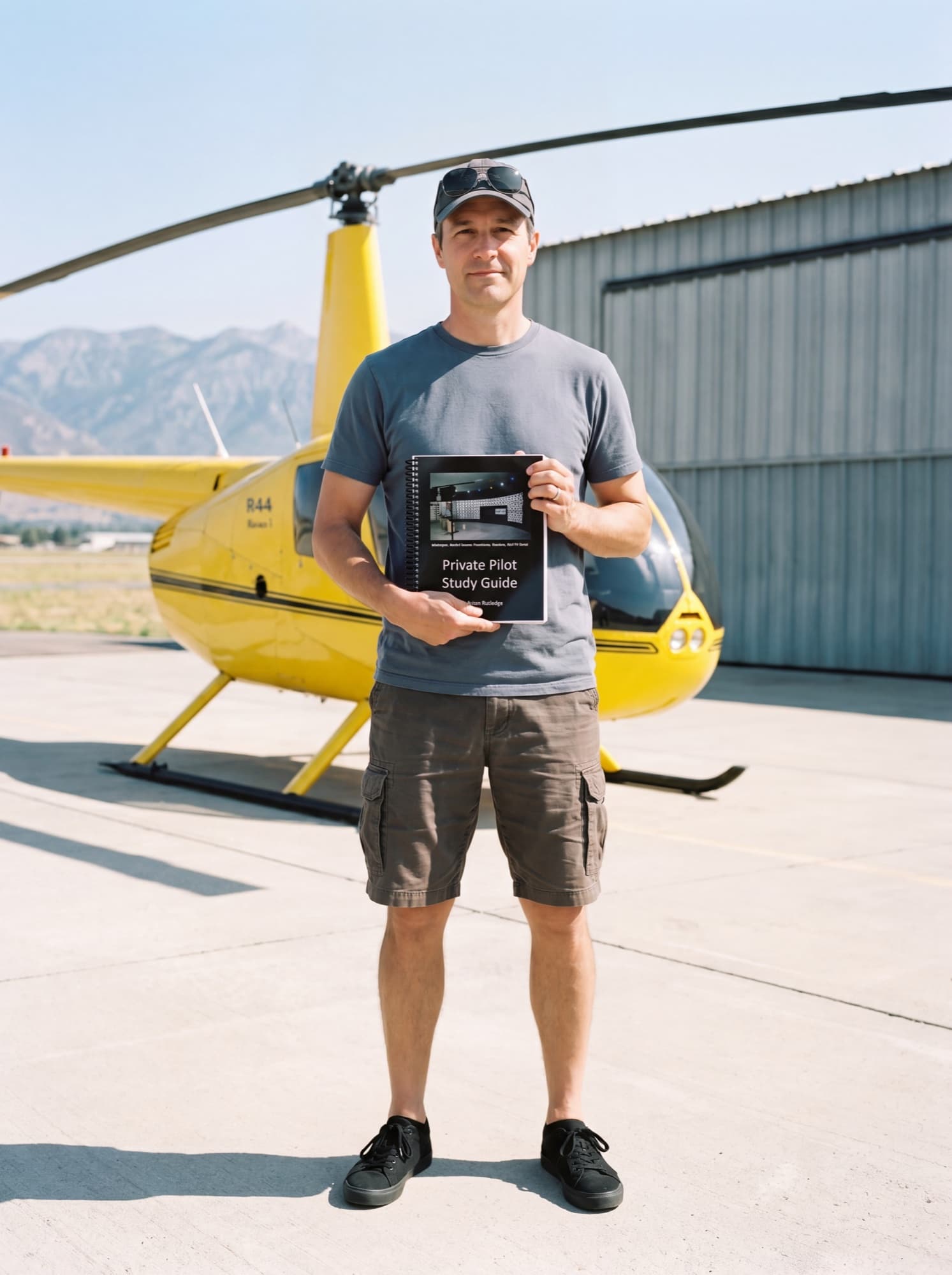
Private Pilot Study Guide by Brian Rutledge: A Review
Here is what I keep coming back to.
The morning of my check ride, the examiner sat across from me at a laminate table in the FBO, opened his folder, set down his pen, and asked me to explain retreating blade stall in language a passenger could actually understand. Not handbook language. Passenger language. The kind you would use with someone buckled into the seat beside you, trusting that you know what you are doing.
I sat there a beat too long and realized the answer I had ready was one I had mostly built at my own kitchen table, early on Saturday mornings, with Brian Rutledge's Private Pilot Study Guide open in front of me. Not his words exactly. My words. But his structure had done its work. The examiner did not need to know that. The answer was there.
I passed the check ride that afternoon. If I had to point to one single study tool that helped get me there, this would be the one.
What kind of book is this?
Private Pilot Study Guide is a spiral-bound oral-exam study manual for civilian helicopter private-pilot applicants working toward the FAA check ride under the Practical Test Standards. It is not really a couch book. It is a kitchen-table book. Maybe a desk book if your desk is less cluttered than mine usually is.
Rutledge organizes it by PTS Areas of Operation and walks task by task through the oral side of the check ride. The in-flight material is not really the point here, and he mostly leaves that where it belongs, in the aircraft and with your instructor.
Each section is split in two. First, you get the questions by themselves. Then later, you get the same questions again with Rutledge's answers. That sounds simple, which it is. It is also the reason the book works.
This is not a written-test prep system. It is not a substitute for the FAA handbooks, the AIM, the regulations, or good instruction. It is a narrower tool than that. Also a better one, within its lane.
What it does that most study materials do not do
Alright, let's think about it this way: most aviation study materials are built to help you recognize information. An oral exam requires you to produce it.
Those are not the same skill.
You can read the Rotorcraft Flying Handbook until the pages start looking familiar, but when somebody is sitting across from you asking real questions in real time, familiarity is not enough. You need complete thoughts that come out of your mouth in the right order without sounding like you are trying to assemble them out of spare parts while the clock runs.
Rutledge seems to understand that. The book makes you answer first and compare second. That matters. You write your answer down in the blank section, then flip forward and see what you missed. Produce. Compare. Find the gap. Close the gap. Repeat.
That is the training loop. Not glamorous, but then neither is most worthwhile preparation.
The other thing the book does well is get the shape of examiner questions right. Not every question, obviously. No guide can promise that. But enough of the rhythm, the angle, and the categories of questioning that the real oral feels familiar instead of alien.
It is the kind of thing you only learn the hard way, that studying facts and practicing answers are related but not interchangeable tasks.
How I actually used it
The method ended up mattering almost as much as the book.
I bought the spiral-bound copy on purpose because I wanted it to lie flat on the kitchen table. I kept a pen clipped into the coil. Every Saturday morning, usually before anyone else in the house was up, I worked through one task the way Rutledge intended. I wrote my answers in the blank section first. Then I checked them against his.
Some sections went fine. Some revealed that I knew less than I had been telling myself I knew, which is always a useful discovery if made early enough.
I left the wrong answers there for a while instead of erasing them right away. I wanted to see my own bad thinking on the page. There is something clarifying about being unable to hide from your earlier version of confidence.
Later in the process, I had Rachel read random questions to me while I was making dinner so I could practice answering out loud with my hands busy. I also had my brother throw follow-ups at me over the phone. He is not a pilot, which actually helped. Non-pilots ask the exact sort of question that reveals whether you understand something or have only memorized its packaging.
By check-ride week, the book was bent, dog-eared, marked up, and carrying a couple faint ring stains that I am choosing to call evidence of faithful use rather than poor discipline.
What to expect, what not to expect
Expect a working tool. Expect something meant to be written in, flipped through, and used repeatedly. Expect plain language and a practical voice.
Do not expect it to replace the FAA source material. It will not. It is not trying to. If you treat this as your whole study plan, you are setting yourself up for an awkward morning.
My one real caution is exactly that: use it alongside the handbooks, the PTS, the regulations, and an instructor who takes your oral prep seriously. Rutledge gives you structure and repetition. The FAA materials still give you the full field of knowledge you are being held to.
In other words, this is a very good square. It is not the entire shop.
Who this book is for
- Civilian helicopter private-pilot applicants preparing for the FAA oral.
- Students who have read the source material and now need to find out whether it actually stuck.
- People who learn by answering, not just by highlighting.
- Applicants whose oral-answer muscle is weaker than their flying muscle.
Who this book is probably not for
- Anyone looking for one book to cover the entire certificate.
- Pilots wanting in-flight coaching more than oral preparation.
- People who prefer digital-only studying and do not want to write in a book.
The spiral binding and write-in format are part of why this works. That is not a flaw. That is the design.
One more thing
A friend asked me recently what I would tell someone just starting civilian helicopter training. I ended up saying three things. Fly as consistently as your life and budget honestly allow. Respect the oral as its own skill instead of assuming it will take care of itself. And buy the Rutledge book early.
That last answer surprised me a little, but only because it came out so quickly.
My copy is still on the shelf above my desk. It has pencil notes in the margins, a correction my instructor made me rewrite, and the general worn look of something that was actually used instead of admired. I like books like that.
I do not know, that is probably the highest compliment I can give a study guide. It became part of the work, and the work held.
— D.